
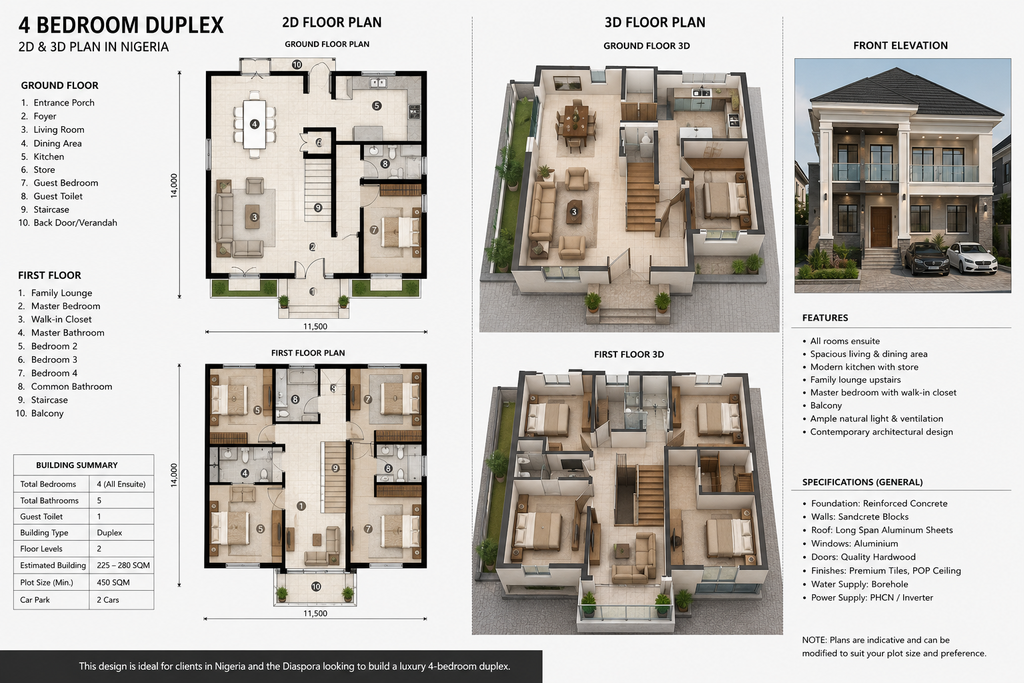
How to Build a House in Nigeria From Abroad Safely: Complete Guide
Building a house in Nigeria while living abroad is completely possible, but it requires a structured system for due diligence, design, budgeting, procurement, construction monitoring and quality control.
Many Nigerians in the diaspora want to build homes in Lagos, Abuja, Port Harcourt and other Nigerian cities but worry about contractors, material prices, project delays, poor workmanship and financial accountability.
The solution is not to avoid construction.
The solution is to build with a professional process.
Can You Build a House in Nigeria While Living Abroad?
Yes.
A property owner does not necessarily need to be physically present at every stage of construction.
However, remote construction requires reliable local professionals and proper documentation.
Your project should have clearly defined responsibilities for:
- Design
- Cost estimation
- Procurement
- Construction
- Supervision
- Quality control
- Payments
- Reporting
- Approvals
- Handover
Step 1: Verify Your Land
Before spending money on construction, ensure the property has undergone appropriate legal and technical due diligence.
Depending on the circumstances, this may involve:
- Title verification
- Survey verification
- Ownership investigation
- Planning considerations
- Physical site inspection
- Litigation searches where appropriate
Do not rely solely on the seller’s documents or an agent’s assurances.
Step 2: Assemble Your Professional Team
A substantial residential project may require several professionals.
Depending on the project, these may include:
- Architect
- Structural engineer
- Quantity surveyor
- Services engineers
- Surveyor
- Geotechnical/soil investigation professionals
- Project manager
- Contractor
- Interior designer
Professional credentials should be verified where applicable. ARCON, for example, maintains registers and provides mechanisms for verifying architects and architectural firms.
Step 3: Develop Your Architectural Design
Do not begin construction based on an informal sketch.
A proper project should have sufficiently developed drawings and specifications for the required construction stages.
The design should address:
- Space planning
- Structure
- Electrical systems
- Plumbing
- Lighting
- Air conditioning
- Security
- External works
- Interior finishes
Step 4: Prepare a BOQ
A BOQ or detailed cost plan gives you a better understanding of the financial requirements of your project.
It can help you understand:
- Quantities
- Materials
- Labour
- Work sections
- Estimated costs
- Variations
For diaspora homeowners, this is especially valuable because you cannot easily visit local markets to verify every purchase.
Step 5: Verify Your Contractor
Before appointing a contractor:
- Review previous projects.
- Speak with previous clients.
- Inspect completed work.
- Check the contractor’s technical capacity.
- Understand their proposed payment structure.
- Request a detailed proposal.
- Establish who controls procurement.
- Agree how variations will be handled.
Step 6: Sign a Construction Agreement
Your contract should clearly establish:
- Scope of work
- Price or pricing mechanism
- Payment milestones
- Programme
- Quality standards
- Materials
- Variations
- Responsibilities
- Defects
- Termination
- Dispute resolution
A properly drafted contract should be reviewed for your specific project and circumstances.
Step 7: Establish Remote Reporting
You should receive regular information about:
- Work completed
- Work planned
- Materials delivered
- Labour
- Expenditure
- Delays
- Variations
- Quality issues
- Photographs
- Videos
This allows you to make decisions without being physically present.
Step 8: Use Milestone Payments
Avoid paying simply because a contractor asks for money.
Payments can instead be tied to agreed milestones, subject to the terms of your contract and professional certification where appropriate.
Step 9: Carry Out Independent Inspections
Critical stages can be inspected before the project proceeds to the next stage.
Examples include:
- Foundation
- Reinforcement
- Concrete
- Roofing
- Waterproofing
- Electrical installation
- Plumbing
- Finishes
- Final snagging
Common Mistakes Nigerians Abroad Make
Common problems include:
- Choosing contractors based only on personal recommendations
- Paying large amounts without documentation
- Changing specifications constantly
- Building without a clear budget
- Failing to monitor materials
- Having no independent inspection
- Relying entirely on photographs
- Allowing uncontrolled variations
Final Thoughts
Building a house in Nigeria from abroad becomes much easier when the project is managed as a professional investment rather than an informal family arrangement.
Your objective should be simple:
Know what is being built, know what you are paying for, and maintain evidence of progress.
If you are a Nigerian in the diaspora planning to build in Nigeria, professional construction management and remote monitoring can help you maintain greater visibility and control throughout the project.